



 Русский
A Glimpse of Bad Homburg What to see in the spa town of Bad Homburg just a stone's throw from Frankfurt in only a few hours

The Taunus Mountains are an ancient range in southwestern Germany. Two thousand years ago, the Roman frontier known as the Limes ran across these hills, marking the edge of the mighty Roman Empire. Today, their gentle green slopes create a mild microclimate, while charming spa towns are scattered along their foothills. Even a short visit can turn into a memorable adventure for the whole family.
Once the capital of the Landgraviate of Hesse-Homburg, Bad Homburg owes much of its beauty to generations of landgraves who spent more than 250 years shaping their estates. Their legacy is an extraordinary collection of parks and gardens—among the largest in Germany—where a leisurely walk soon feels like a treasure hunt, with hidden monuments, springs, sculptures, and historical landmarks waiting to be discovered among the trees.
Avenue of Springs
Eight mineral springs are hidden throughout the park, each with its own distinctive taste and therapeutic properties. Two are especially worth seeking out. Elisabethenbrunnen is famous for its unique mineral composition, unlike any other spring in Germany. Then there is the Salt Spring, whose lively effervescence and invigorating character are remarkably reminiscent of champagne—refreshing the mind, clearing the thoughts, and awakening the senses.
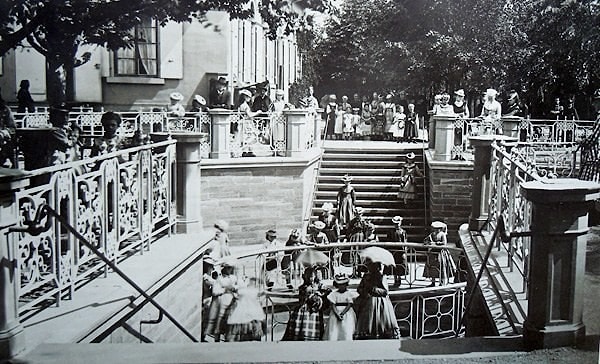
Photo: This is what one of Bad Homburg's mineral springs looked like a century ago. Remarkably, it has hardly changed since then...
 Photo: ...except that a casino has appeared right next to it
During the 19th century, these healing waters attracted kings, queens, and aristocrats from across Europe. After recovering from illness, King Chulalongkorn of Siam expressed his gratitude by sending Bad Homburg an exquisitely carved Thai Sala—a traditional shrine for the guardian spirit of the spring—lavishly decorated with gilded ornaments and precious stones.
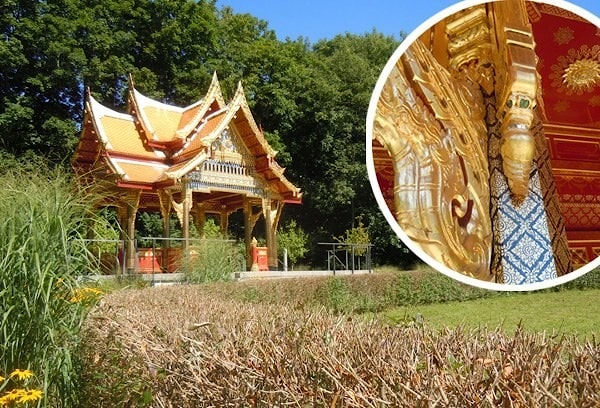
Photo: One of Bad Homburg's two nearly identical Thai Salas.
The townspeople were so captivated by its beauty that they placed it in one of the park's most prominent locations. A century later, a descendant of the Siamese king presented Bad Homburg with a second Thai Sala, which was installed beside the spring itself.
It's no coincidence that the town hosts its annual Thai Festival here every summer.
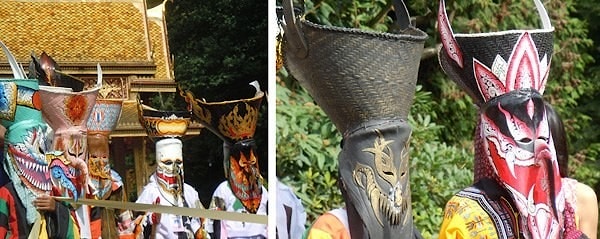
Photo: The masks worn during Bad Homburg's Thai Festival seem inspired either by childhood nightmares—or by pure psychedelia.
Monuments
As you wander through the park, you'll suddenly come across the bust of Maximilian Bircher-Benner, the inventor of muesli, erected by admirers of healthy living. A little farther on stands the remarkable sculpture Thirst: a young woman seated in the lotus position holds a bowl from which two panthers drink.
Nearby, two Hare Stones, standing about 250 metres apart, commemorate the legendary spot where a landgrave supposedly felled an unsuspecting hare with a single rifle shot.
Scattered throughout the park are dozens of other curious sculptures and monuments, each with its own fascinating story waiting to be discovered.

Photo: Besides its mineral springs and sculptures, the park is full of wide open lawns where almost anything goes—and elegant fountains that serve as handy landmarks on the way to the small lake.
The Landgrave's Castle

Among Bad Homburg's historical figures, Landgravine Elizabeth of Hesse-Homburg is held in particularly high esteem. The sister of the British monarch of her time, she married the Landgrave at the age of forty-eight, moved to Bad Homburg, and brought with her the traditions of the English landscape garden.
Today, visitors are welcomed by magnificent flower beds, an elegant orangery, and two towering Cedars of Lebanon, presented to Elizabeth by her brother as a wedding gift.
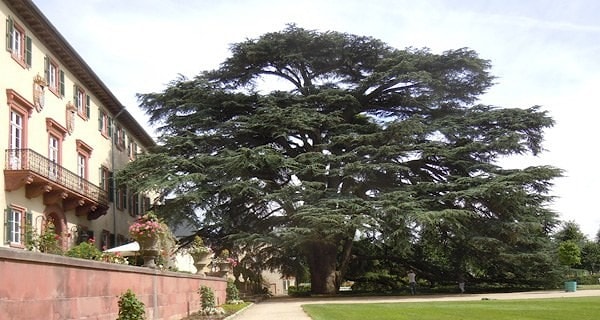
Photo: The astonishingly Cedars of Lebanon planted for Landgravine Elizabeth of Hesse-Homburg have grown into true giants.

Photo:One of the most remarkable architectural sculptures I've ever seen crowns the castle gate. The mounted Landgrave seems to burst right out of the wall.
Gardens
From the lake in the castle park, a broad avenue stretches for almost 8 kilometres towards the Taunus Mountains, linking a series of gardens that once belonged to the Landgrave's children. Each has its own distinct character.
Gustav's Garden charms visitors with its delightfully untamed, almost forgotten atmosphere, while Philip's Garden is filled with imaginative sculptures carved from living trees.
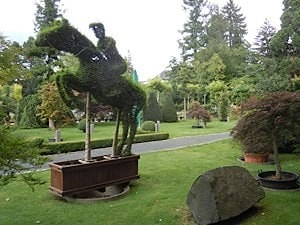
Photo: Philip's Garden is full of remarkable living tree sculptures.
One of the true highlights is the charming Pleasure Forest, designed in an Anglo-Chinese style. At the centre of its lake, on a tiny island, stands a dazzling white pavilion that seems almost unreal.
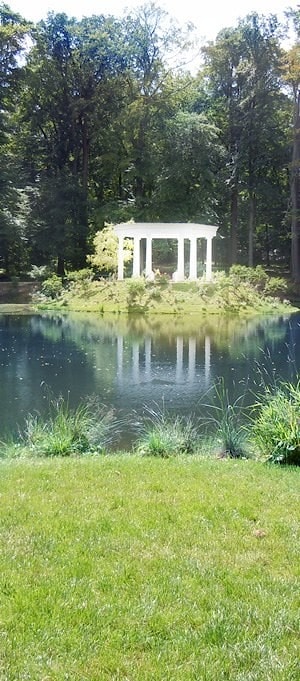
Photo: The pavilion in the Pleasure Forest leaves a lasting impression. Yet no photograph can quite capture its almost otherworldly brilliance. As is so often the case, trying to describe it with sparkling eyes and animated gestures is ultimately a hopeless task.
In the Deer Garden, the graceful residents are so accustomed to visitors that they'll often come within arm's reach.

Photo: A couple of photos are simply not enough for the Deer Garden—especially when the does happily pose for your camera just a few steps away.
While exploring the Great Spruce woodland, don't miss the memorial stone erected by the Landgrave in memory of his beloved horse. Its Latin inscription reads:
"Here rests the most faithful horse in the world. And if friendship can exist between man and animal, then I can truly say that my friend lies buried here."
Bad Homburg is also home to the unique Garden of Fragrance, where plants are grouped by theme—culinary herbs, medicinal plants, roses, and meadow flowers. Informative signs accompany every section, complete with Braille inscriptions for visually impaired visitors..

Photo: The flowers and leaves in the Garden of Fragrance release wonderfully delicate aromas. Somehow, despite growing side by side, each plant manages to preserve its own unique scent.
The Old Town

It's hard to believe that this entire district came within a hair's breadth of demolition in the 20th century. Fortunately, the people of Bad Homburg fought to preserve their historic quarter. Thanks to their efforts, visitors can still wander through its medieval streets and discover the Town Hall Tower, the Blunt Tower, and the intriguingly named Witches' Tower.
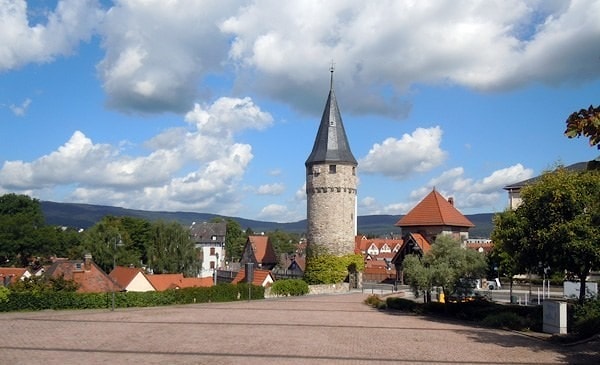
Photo: The Witches' Tower—a tower that, despite its name, never seems to have attracted a single witch.
As for the White Tower, the unmistakable symbol of Bad Homburg, there's simply no way you'll miss it.
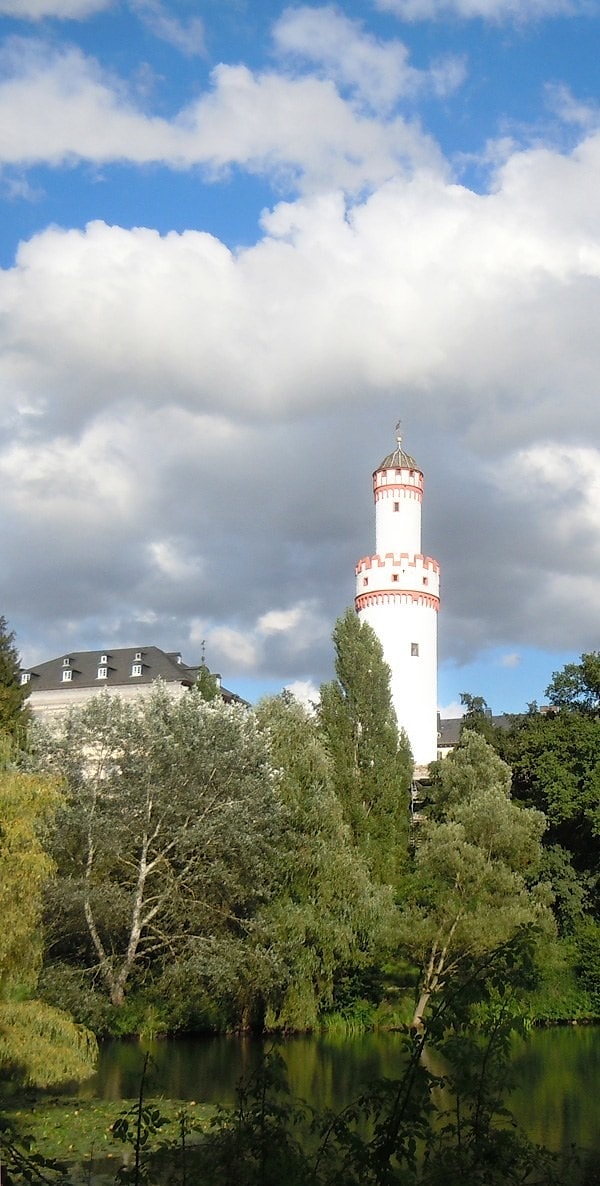
Photo: The White Tower—the iconic landmark of Bad Homburg.
Against a bright blue sky, the White Tower looks cheerful and almost fairytale-like. But as dusk settles, it takes on an unmistakably mysterious, almost supernatural appearance.
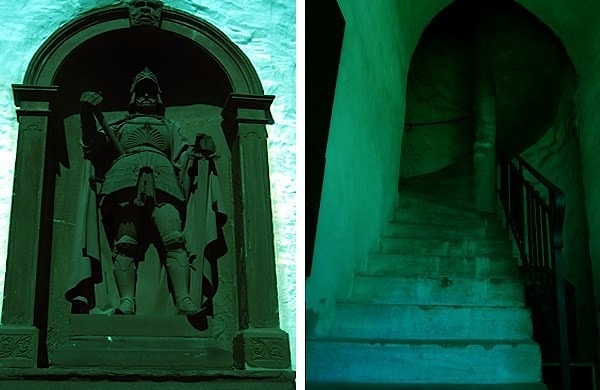
Photo: At twilight, Bad Homburg's White Tower resembles a ghostly white apparition. The knight high above the entrance seems about to come to life, while the spiral staircase behind the heavy iron gate appears to hide secrets of its own.
ххх
A Short Detour...
Picture the scene.
The only entrance to the White Tower is blocked by a massive iron gate wrapped in a thick chain and secured with an enormous padlock. It's obvious the tower has been locked for a long time.
Then, from somewhere above—up on the spiral staircase—you hear the soft voice of a little girl singing an old German folk song.
You check the gate. Definitely locked.
You walk all the way around the tower. There isn't another entrance anywhere.
There is simply no way anyone could be inside.
And yet the faint singing continues behind the barred gate, patiently following its haunting melody.
At this point, the whole situation begins to feel uncannily like the opening scene of a horror film.
Even worse, the voice is getting closer.
A chill runs down your spine. Every sensible instinct tells you to leave—quietly, but quickly. Yet somehow you remain rooted to the spot, listening to that eerily gentle song.
The ending, fortunately, is far less dramatic.
A minute later, another voice appears—this time an elderly man's. Soon a grandfather and his granddaughter descend the staircase, produce an impressively large key, unlock the gate, step outside, and carefully lock it again behind them.
As it turns out, for just a couple of euros (plus a refundable key deposit), the ticket office lends visitors a personal key to the tower. Once inside, you're free to climb to the viewing platform and stay as long as you like.
ххх
Curiously, every loophole in the White Tower has been fitted with iron bars to prevent visitors from climbing through them. The only exception is the large windows at the very top, which swing open wide enough to stand in, revealing magnificent views over the town, the park lake, and the ancient Taunus Mountains, their rounded peaks softened by countless centuries.
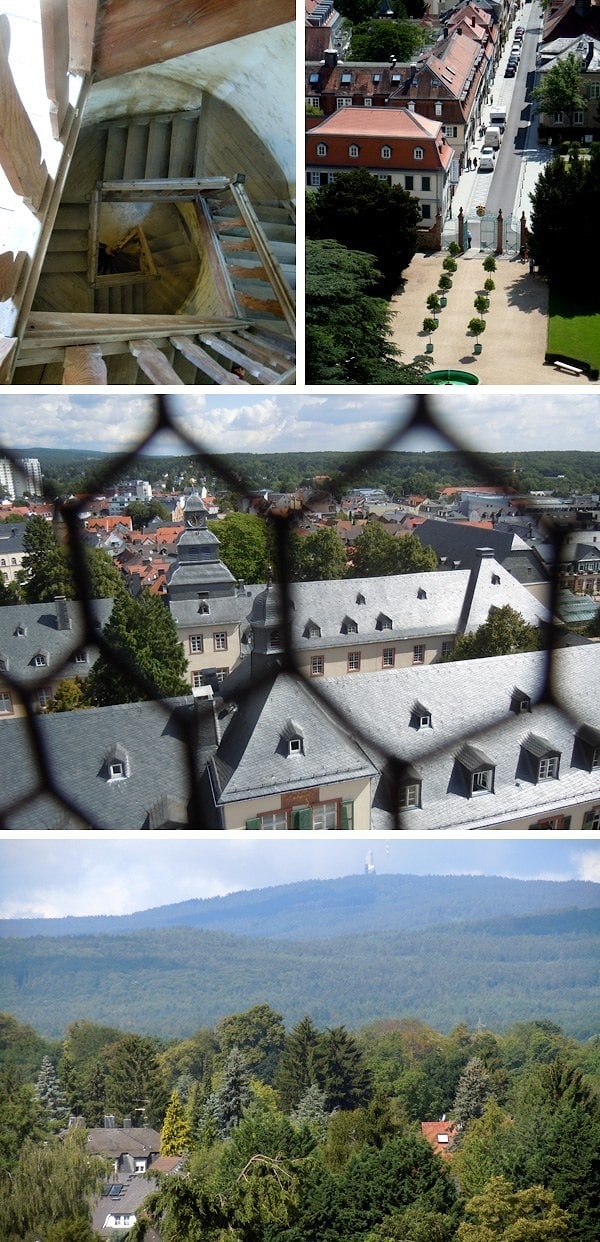
Photo collage:
- Top left: The spiral staircase begins in solid stone but higher up transforms into wonderfully creaky wooden steps straight out of a classic horror movie.
- Top right: The entrance gate to the Landgrave's Castle, seen from the top of the White Tower.
- Centre: Every loophole in the tower is securely protected by iron bars.
- Bottom: The distant Taunus Mountains—and the tower perched high on one of their peaks.
It's almost impossible to resist climbing that very tower visible from the White Tower, standing high in the Taunus Mountains. Although it's considerably shorter than its famous counterpart in Bad Homburg, the panorama is magnificent, made even more dramatic by unusually low clouds with remarkably flat undersides drifting overhead.
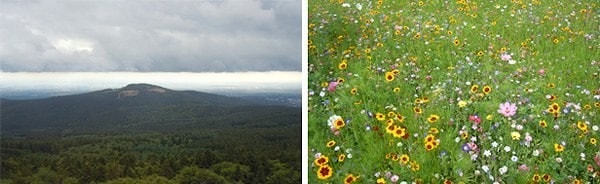
Photo (left): Bad Homburg seen from one of the highest points of the Taunus Mountains. In winter, these hills belong to skiers; throughout the rest of the year they're popular with mountain bikers, cyclists, and hikers happy to spend a day covering twenty kilometres or more on foot.
Photo (right): On the way back, we came across an astonishingly cheerful meadow of wildflowers. It seemed to mark an invisible boundary between the mountains, crowded with dark rain clouds, and Bad Homburg's own little pocket of sunshine, where rainfall is surprisingly rare.
Bad Homburg is also home to Germany's first golf course. It was here, too, that one of Germany's earliest casinos opened its doors—long before gambling made Monte Carlo famous.
Beyond its parks, the entire town is dotted with unusual trees and plants, each meticulously labelled in the characteristically German fashion. One specimen that particularly caught my eye was a 200-year-old Chilean monkey puzzle tree growing beside one of the grand villas. With its hose-like branches covered in sharp, overlapping leaves, it looks more like something from another planet than a tree.

Photo: The 200-year-old monkey puzzle tree looks like a visitor from another world.
The Homburg Hat
Bad Homburg's delightful local museum houses an impressive collection of hats. Each display case explores a different theme, from chefs' toques and clergy headwear to firefighters' helmets, military caps, and an astonishing variety of elegant ladies' hats.
The town is also the birthplace of the famous Homburg hat—the soft felt hat with a curled brim that became fashionable after being popularized by King Edward VII of Britain.
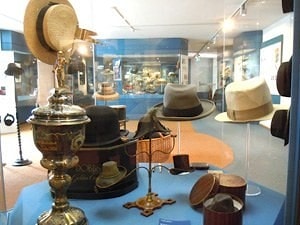
Photo: Just a tiny glimpse of the extensive hat collection at Bad Homburg's Hat Museum.
Taunus Therme
If soaking in warm mineral water is your idea of heaven, Taunus Therme is not to be missed. These Asian-inspired thermal baths are so popular that every Friday evening visitors travel from nearby Frankfurt for the famous Long Night. For a small additional fee, you can spend five relaxing hours—until 2 a.m.—floating beneath the moonlight, sampling Thai delicacies, and exploring an impressive selection of saunas.
The ground floor features several mineral pools, while the upper level offers the full German spa experience: pools, saunas, steam baths, and solariums. As is customary in Germany, this area is clothing-free. Admission costs around €15.
Just beyond the spa, in Hardtwald Forest, you'll also find an extensive outdoor parkour training course equipped with dozens of exercise stations and fitness obstacles.
The Limes
If you're feeling adventurous—and perhaps a little like a Roman legionary—set off on foot for the Saalburg Roman Fort. The trail leads through a dark, atmospheric forest but is so well signposted that getting lost is virtually impossible.
Founded some two thousand years ago, Saalburg was one of the forts guarding the Limes, the Roman Empire's remarkable 500-kilometre frontier—the first fortified border system of its kind in history.
Life on the frontier is brought vividly to life through reconstructed barracks, kitchens, bathhouses, bakeries, and interactive exhibits designed to engage visitors of all ages. Adults can even stop for a meal at the fort's traditional tavern.
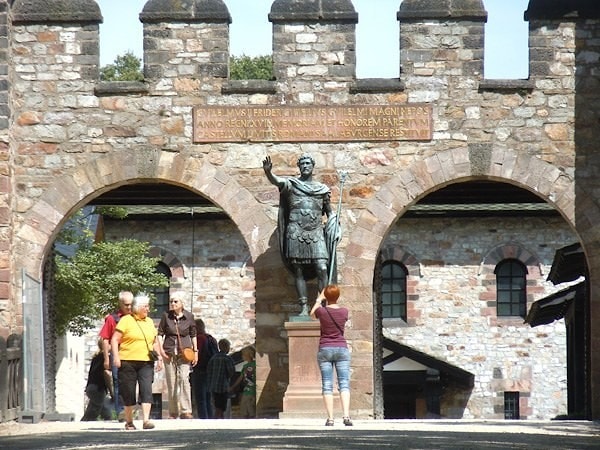
Photo: Two thousand years ago, Saalburg was not only a military outpost but also a workshop where countless marble busts of Roman emperors were produced. All that was needed was an original bust, a block of marble, a measuring device—rather like a giant pair of calipers—to compare the copy with the original, and a skilled stonemason's tools. Today, children can honour that creative tradition by assembling colourful Roman-style mosaics from thousands of tiny stone tiles, which they are welcome to take home as souvenirs. The tiles, backing board, and glue are all provided free of charge.
The Roman frontier survived for about 150 years before collapsing under the pressure of invading tribes. Today, only a handful of commemorative stones and reconstructed sections of the wooden palisade remain to remind visitors where one of history's greatest empires once ended.
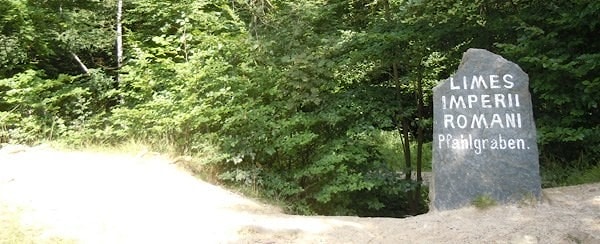
Photo: The Limes—the frontier of the Roman Empire. Two thousand years later...
In Summary
Bad Homburg is much more than an elegant spa town.
It's a place where mineral springs, royal history, medieval towers, hidden gardens, Thai temples, Roman frontiers, and ancient forests come together like pieces of an elaborate puzzle. The more of those pieces you discover, the more memorable your visit becomes.
— The End —


The site is powered by Nestorclub.com
Copyright © 2009-2026 Cats & Dreams. All rights reserved.